Skip to content

Acoustic 3 Sided Panels

Most rooms have a noise problem that nobody has named yet. The echo from hard floors and bare walls, the way voices bounce around a kitchen-diner...


Most rooms have a noise problem that nobody has named yet. The echo from hard floors and bare walls, the way voices bounce around a kitchen-diner, the television turned up louder than it needs to be because the room isn't absorbing any of the sound. It tends to be noticed as a vague sense that the room isn't quite comfortable rather than as a specific acoustic complaint, and it rarely gets addressed because most people don't think of it as something furniture or wall treatment can fix. Acoustic wall panels fix it, and they do it while looking genuinely impressive in the room rather than looking like a solution to a problem.


Our three-sided acoustic wall panels are wall-mounted slatted panels finished on three sides for a seamless appearance from every angle. They are available in different slat widths and finishes designed to suit contemporary interiors, and they perform as well as they look: the acoustic felt backing reduces echo and improves sound quality in a room in a way that is immediately noticeable once the panels are installed. They suit living rooms, media walls, home offices, and commercial environments, and they install without professional help. Finance is available on many of our panels, subject to status. We deliver nationally across the UK, and our Manchester showroom is open if you'd like to see the panels in person before you order.

What's in this collection

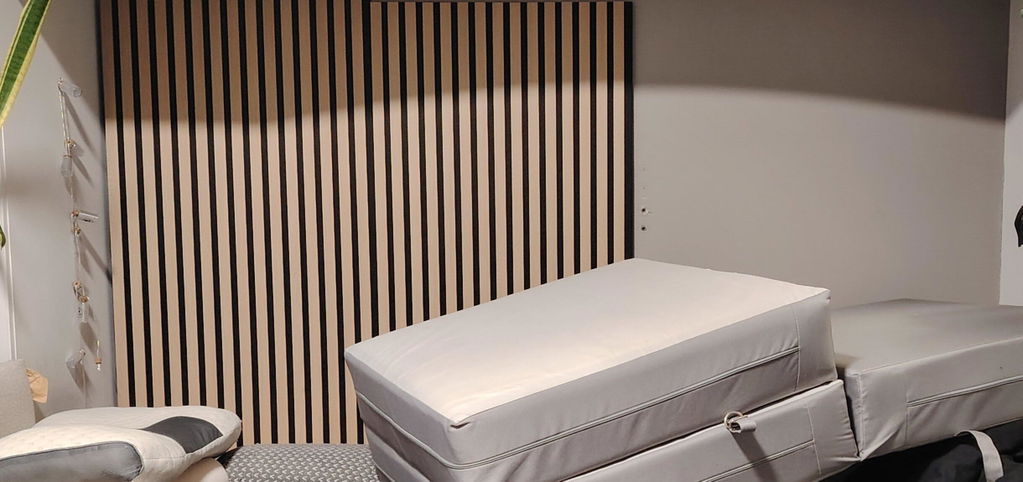
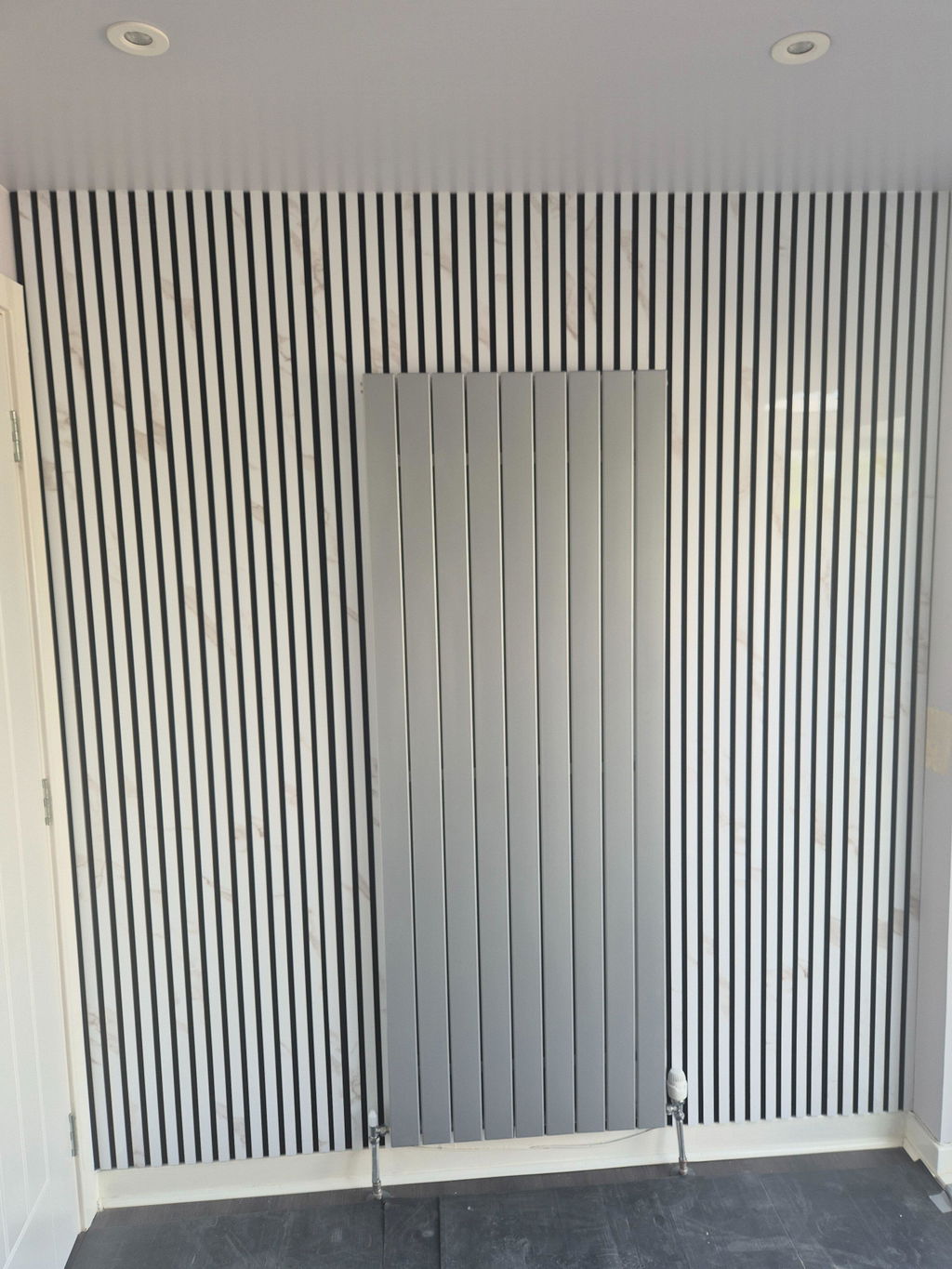
Our three-sided acoustic wall panels are slatted wall panels with a precisely spaced linear design mounted on an acoustic PET felt backing. The three-sided finish means the panel presents a consistent, clean appearance on the face and both side edges, which gives a wall installation a professional and seamless result rather than the raw edge that single-faced panels produce when viewed from an angle.

Slat widths and spacing vary across the collection, giving different visual weights and characters to the finished wall. Our wide slat panels use 40mm slats with 10mm spacing, which gives a bold and architectural linear quality suited to rooms where the panels are a design statement as much as an acoustic solution. The felt backing is 9mm thick and is made from up to 60% recycled materials. Each panel measures 2400mm high by 600mm wide, which suits both full-height wall installations and more contained feature wall applications.

Finishes are available in different colourways, and the combination of slat finish and felt backing colour defines the overall character of the panel in the room. A white slat on a white felt backing is a clean and contemporary combination that suits modern interiors with a restrained palette. Other colourways are available and suit different room directions.

What acoustic panels actually do

The acoustic benefit of wall panels is real and worth understanding clearly rather than treating as a secondary feature to the visual.

Hard surfaces reflect sound. In a room with wooden floors, plaster walls, and large windows, sound bounces between those surfaces and creates the echo and reverberation that makes the room feel louder and less comfortable than it should be. Adding soft or porous surfaces to the room, upholstered furniture, rugs, curtains, absorbs some of that reflected sound and reduces the echo. Acoustic wall panels do the same thing at the wall level, and the felt backing is specifically engineered for that absorption rather than being a soft material that happens to have some effect.

Our panels reduce echo and improve sound quality by up to 22%, which is a meaningful difference in a living room or home office where the acoustic environment affects how comfortable the room is to spend time in. A media wall with acoustic panels behind or alongside it produces noticeably better sound from a television or speaker system because the panels are reducing the reflected sound that muddies the audio rather than adding to it. A home office with panels on one or more walls reduces the echo that makes video calls feel hollow and tiring. These are practical improvements to rooms that most people are currently living with unnecessarily.

The felt backing that delivers the acoustic performance is made from up to 60% recycled materials, which means the environmental credentials of the product are part of how it is made rather than a claim applied afterwards.

Design and finish

The visual case for acoustic wall panels is as strong as the acoustic one, and in most installations it is what draws people to them in the first place. The slatted linear pattern adds depth and texture to a wall in a way that paint or wallpaper doesn't: the three-dimensional quality of the slats creates shadow lines that shift with the light, and the result is a wall that looks genuinely different at different times of day and from different angles in the room.

Wide slat panels at 40mm with 10mm spacing give a bold and architectural character that suits rooms where the panel installation is intended to be the main feature of the wall. The spacing is generous enough that the felt backing between the slats is clearly visible as part of the design rather than incidental, and the overall effect is a substantial linear pattern with real depth and presence. In a room with clean, contemporary furniture and a restrained palette, a wide slat panel wall is often the element that gives the room its identity.

The three-sided finish is the detail that distinguishes a quality installation from a compromised one. A panel finished on the face only looks correct from directly in front but shows raw edges when viewed from the side, which matters in any installation where the edge of the panel is visible, a column of panels in a room, a panel that doesn't run full wall to full wall, or a ceiling installation where the panel is seen from below and from the side simultaneously. The three-sided finish removes that compromise entirely.

The panels are suitable for both wall and ceiling installation, which opens up applications that single-face panels don't allow. A ceiling installation in a living room or dining room adds the acoustic benefit overhead, where much of the echo and reverberation in a room originates, while adding a design detail that few residential interiors have explored.

Installation and maintenance

The panels are designed for DIY installation and do not require professional fitting. Each panel is a self-contained unit that mounts directly to the wall, and a standard installation does not require specialist tools or skills beyond what a confident DIY approach would involve. The 2400mm height of each panel suits full-height wall applications in rooms with standard ceiling heights, and panels can be combined to cover wider wall areas by running them side by side.

No oiling or ongoing treatment is required. The slat material does not need the periodic maintenance that natural wood products typically require, which means the panels look as good in three years as they do on installation day without any intervention. Cleaning is straightforward: a soft dry cloth or a gentle vacuum with an upholstery attachment keeps the felt backing clear of dust, and the slat surfaces wipe clean easily.

If you have questions about a specific installation, whether the panels will work on your wall type, how to approach a ceiling application, or how many panels a particular wall area requires, get in touch before you order and we can work through the specifics with you.

Why buy from Shawcross

We're based in Manchester and our showroom is open if you'd like to see acoustic panels in person before buying. The linear quality of a slatted panel and the depth it adds to a wall is one of the things most difficult to assess from product photography: seeing the panels in real light, understanding how the shadow lines shift across the slats, and assessing the finish quality of the three-sided edge are all things a visit makes clear quickly.

We deliver nationally across the UK, and you can contact us at any stage for guidance on finish choice, installation approach, or how many panels your specific wall or ceiling area requires before you order.


Acoustic 3 Sided Wall Panel FAQs

How much do acoustic wall panels actually reduce noise?

Our panels reduce echo and improve sound quality by up to 22%, and it is worth being clear about what that means in a domestic setting. Acoustic panels are not soundproofing: they do not prevent sound from travelling between rooms or entering from outside. What they do is reduce the reverberation and echo within the room itself, which is the reflection of sound off hard surfaces that makes a room feel louder, muddier, and less comfortable than it should be.

The practical effect in a living room or home office is noticeable. Conversations feel clearer. A television or speaker system produces better audio because the reflected sound that muddies the direct sound is reduced. Video calls in a home office feel less hollow. These are real improvements to the acoustic comfort of a room, and in a space with hard floors and minimal soft furnishings, the difference before and after a panel installation is often more significant than people expect.

For rooms where the goal is actual sound isolation between spaces rather than improved acoustic quality within a room, acoustic panels are one part of a broader approach rather than a complete solution on their own.

What wall types are the panels suitable for?

The panels are suitable for most standard interior wall types including plasterboard, plaster, and masonry walls. The fixing method varies depending on the wall type and the specific installation, and it is worth establishing the right approach for your specific wall before you start rather than improvising on the day.

If you're not certain about the wall type you're working with or the best fixing approach for your specific situation, get in touch before you order and we can advise. An installation that is planned properly from the start produces a better result and causes fewer problems than one where the fixing approach is worked out on the day.

Can acoustic panels be installed on a ceiling as well as walls?

Yes, and a ceiling installation is worth considering specifically for rooms where echo and reverberation are the main concern, because a significant proportion of the reflected sound in most rooms originates at the ceiling. The panels are designed to be suitable for both wall and ceiling installation, and the three-sided finish means the panel presents a clean appearance when viewed from below rather than showing raw edges.

A ceiling installation requires more careful planning than a wall installation in terms of the fixing method and the support structure, and it is worth thinking through the specific approach before you start. If you'd like guidance on a ceiling installation for your specific room, get in touch and we can work through the specifics with you.

How many panels do I need for my room?

Each panel measures 2400mm high by 600mm wide. For a full-height wall installation in a room with a standard ceiling height of around 2400mm, one panel covers 600mm of wall width. A wall that is 2400mm wide requires four panels. A wall that is 3600mm wide requires six panels.

For a feature wall rather than a full wall installation, the number of panels depends on the width of the feature area rather than the full wall width, and panels can be used to cover a specific zone, a media wall, a chimney breast, or a section behind a desk, rather than an entire wall surface.

If you'd like to confirm the number of panels for a specific wall or ceiling area, share the dimensions with us and we'll give you a straight answer before you order.

How do you clean and maintain acoustic wall panels?

No oiling or ongoing treatment is required. The panels are low maintenance by design: the slat material does not need the periodic conditioning that natural wood requires, and the surface holds its finish without any intervention.

For routine cleaning, a soft dry cloth across the slat surfaces removes surface dust without any risk to the finish. For the felt backing between the slats, a gentle vacuum with an upholstery or brush attachment clears dust from the surface of the felt effectively. Avoid wet cleaning the felt backing: the felt is an acoustic material and saturating it with water or cleaning solution affects both its appearance and its acoustic performance. For any marks on the slat surfaces, a lightly damp cloth is sufficient.

How does delivery work, and can I see acoustic panels in person first?

We deliver nationally across the UK. Once your order is placed you'll receive a confirmation, and we'll be in touch to confirm the delivery timescale and arrange a date that suits you. If there's anything about your property worth knowing in advance, such as restricted access or limited parking, let us know when you order so the delivery team can prepare.

If you'd prefer to see acoustic panels in person before you commit, our Manchester showroom is open and you're welcome to come in without any obligation. Seeing the panels in real light, assessing the finish quality and the depth of the slat profile, and understanding how the three-sided edge looks in an installed context are all things a visit makes clear quickly. If you'd like to confirm whether a specific panel is currently on the showroom floor before travelling, just give us a call.