What's in this collection
An extending dining table is a table that can be opened out to add length, increasing the number of people it can comfortably seat. In its everyday position the table sits at its standard size; extended, it provides the seating capacity of a larger fixed table without permanently occupying that floor space.
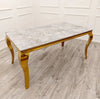
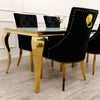
The tables in this collection vary in their closed and open dimensions, surface materials, and base styles. Some sit at a four-seat standard size and extend to seat six; others open from six to eight or more. Surface materials across the collection include ceramic and stone-effect tops, glass dining tables configurations, and other finishes, with base styles ranging from four-leg designs to pedestal and architectural frames.
When an extending dining table makes sense
The right reason to choose an extending table over a fixed one is that your everyday seating need is genuinely smaller than your occasional need, and both situations happen often enough to matter.
A household of four that has six or eight people round for dinner a few times a month has a real use case. The table spends most of its life at four seats, which suits the room and the daily routine, and extends for occasions without anyone having to improvise with a folding table brought in from a spare bedroom. That's the situation an extending table is designed for.
The wrong reason to choose extending is as a contingency for something that almost never happens. If you genuinely only need extra seats twice a year, a fixed table sized for everyday use and a couple of folding chairs for those occasions is a simpler and often more practical solution. An extending mechanism adds complexity and, in most cases, some cost relative to a fixed equivalent. If you're not regularly using the extended configuration, that trade-off doesn't pay off.
The other thing worth being honest about is that extending tables tend to be slightly more visually complex than their fixed equivalents. The mechanism has to live somewhere in the table's design, and at the join between the two halves there is often a visible seam when extended. In most tables this is subtle and barely noticeable across a table set for dinner. But it's a different finish from a continuous fixed surface, and if you're buying a table primarily as a piece of furniture for a room you've thought about carefully, it's worth seeing the extended configuration in the showroom before you commit.
How extending mechanisms work
There are a few main types of extending mechanism, and understanding how they differ is useful when you're deciding between tables.
The most common type uses a central leaf that the two halves of the table draw apart to accommodate. To extend, you open the table from the middle, drop the leaf into the gap, and close the halves back against it. The leaf then stores separately, usually either underneath the table or in a separate location you designate. This is a straightforward mechanism and reliable in long-term use.
Self-storing extending tables have the leaf or leaves built into the structure of the table itself, folded underneath when not in use. To extend, you draw the two ends apart and the leaf unfolds into the gap from within. Nothing needs to be stored separately. This is a more convenient configuration for households that use the extended setting often, because there's no leaf to find and lift into place. The trade-off is that the table is typically heavier and slightly more complex to operate.
A third type uses a butterfly mechanism in which the leaf is hinged in two halves beneath the table and folds up into place when the ends are drawn apart. Similar in principle to self-storing but with a slightly different operation.
The key practical questions for any mechanism are how easily one person can operate it alone, how securely the extended table locks in place, and where the leaf stores if it's not self-contained. These are questions worth answering in person. Our Manchester showroom stocks extending tables and demonstrating how the mechanism works is something we're happy to do before you buy.
Sizes and room planning for extending dining tables
The important thing about room planning for an extending table is that both dimensions need to fit the room properly. The standard size needs to work for everyday use with the right clearance, and the extended size needs to fit the room with the same 90cm clearance on all sides, because that's the configuration you'll be using when the most people are seated and movement around the table matters most.
That second check is the one people sometimes forget. A table that closes to a comfortable 1.5m dining table footprint might extend to the equivalent of a 1.8m dining table, and the room needs to hold the extended dimensions with proper clearance. If it doesn't, the extended table will feel cramped at exactly the moments when you need it to work best.
Work through the following before you decide on a specific table. Measure the room and calculate the maximum extended length the room can hold with 90cm clearance on all sides. Then check the closed dimensions against the space. If both work, you have found your size range. If the room can hold the everyday dimensions but not the extended ones comfortably, an extending table may not be the right solution for that space, and a fixed table sized for the room is the more honest answer.
For larger households or bigger rooms, 2m dining tables in a fixed configuration may be a more practical starting point than extending to that length from something smaller. At the other end of the range, 1.2m dining tables and 1.3m dining tables in extending form suit compact rooms where adding a couple of seats occasionally makes a real difference without the extended size becoming unmanageable.
If you'd like to share your room dimensions with us, we'll work through both the closed and extended size requirements before you commit to a specific table.
Materials in our extending dining tables
Extending tables are available across a range of surface materials. The material choice applies the same considerations as it does for a fixed table, with one additional practical note: the leaf or extension surface needs to match the main table surface closely, and the quality of that match varies between tables and manufacturers.
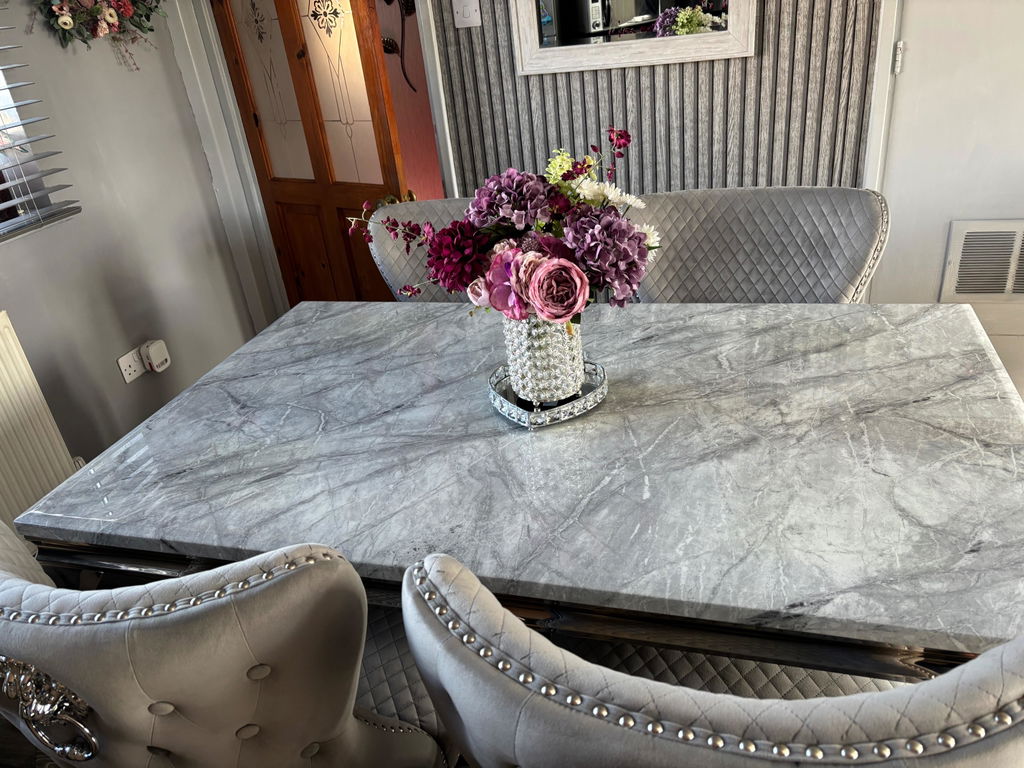
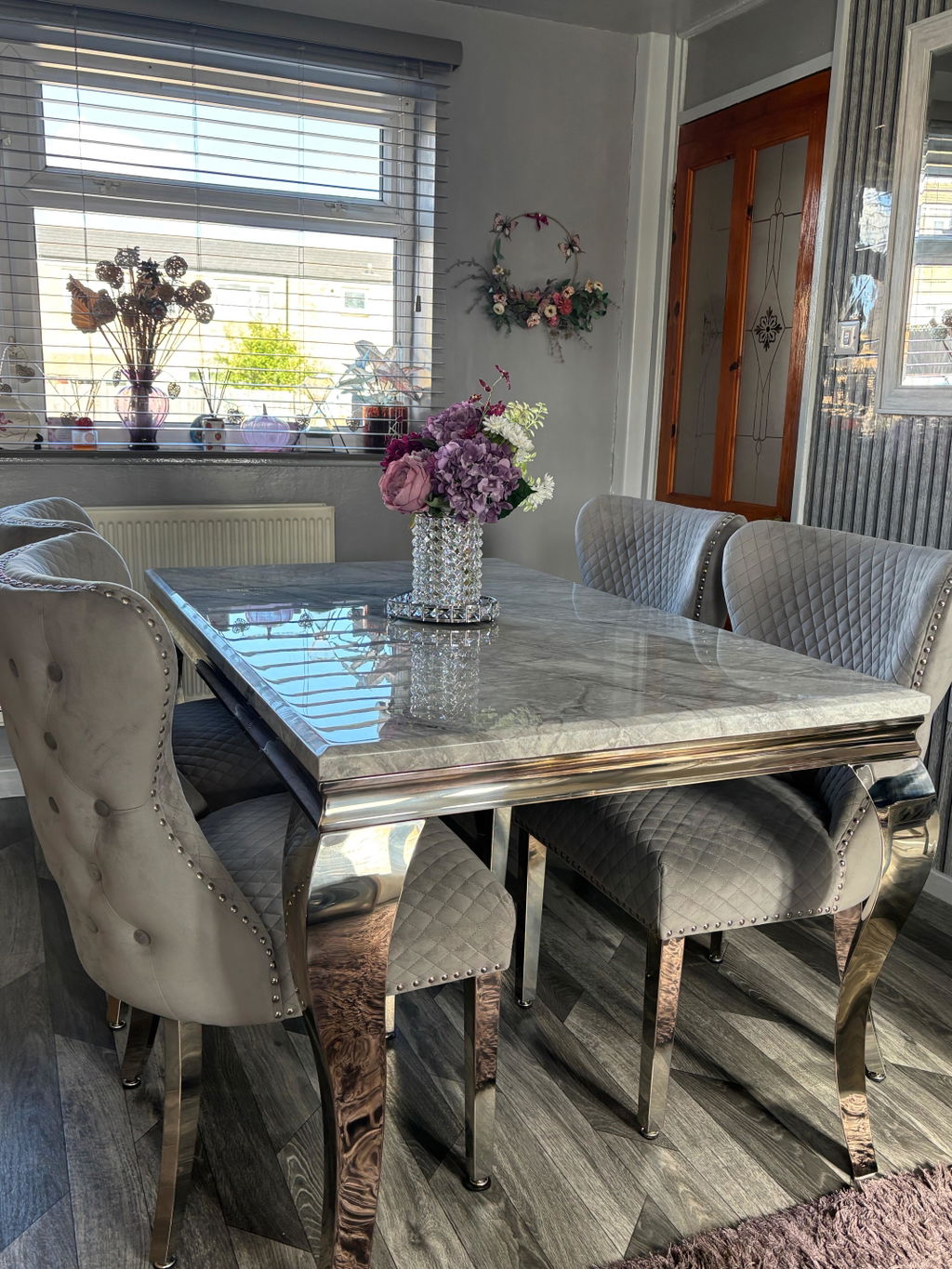
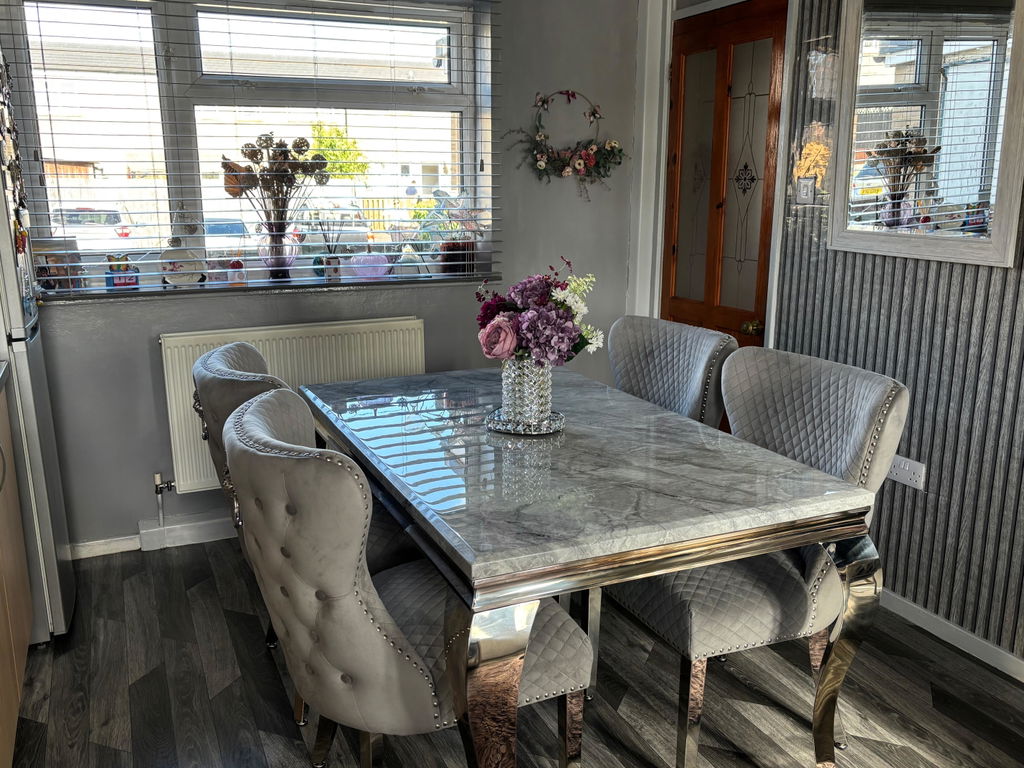
Ceramic dining tables in extending form are one of the most practical combinations for a family. The surface is heat-resistant, non-porous, and wipes down easily, and a ceramic extending table handles daily use well without requiring the care that a real marble surface would. The leaf or extension in a good ceramic table matches the main surface convincingly.
Marble dining tables in an extending configuration are available in real marble and marble-effect ceramic. Because marble is a natural material with genuine variation from slab to slab, the match between the main surface and the leaf can be more variable on a real marble extending table than on a ceramic one. This is worth assessing in person if the surface continuity matters to you.
Glass extending tables operate differently. In most cases the glass is a fixed panel and the extension uses a different approach, typically a separate leaf that is the same finish rather than the same material. It's worth asking about the specific configuration of any glass extending table you're considering.
Each material page covers care and family suitability in detail. The relevant ones to read alongside this page are the ceramic, marble, and glass pages linked above.
Spreading the Cost
Finance is available on many of our dining tables, subject to status. An extending table tends to sit at a higher price point than a fixed equivalent at the same size, and spreading the cost can make the right table more accessible. We're happy to talk through the options at any point.
Why buy from Shawcross
We're based in Manchester and our showroom is open if you'd like to see extending dining tables in person before buying. Of all the things on a product page that are hard to convey accurately, how an extending mechanism feels to operate is probably top of the list. Whether it's smooth, how much effort it takes alone, how secure the extended table feels, and how the join looks across a set table: these are things a visit settles in five minutes that a photograph and a description can only approximate.
We deliver nationally across the UK, and you can contact us at any stage for guidance on sizing, mechanism type, or whether an extending table is the right choice for your specific room and household. If you're deciding between extending and fixed and you'd like a straight view on which suits your situation better, that's the kind of question we're happy to work through with you before you order.