Skip to content
Home  → Dining Tables  → Square Dining Tables

Square Dining Tables

The square dining table tends to get chosen for practical reasons before aesthetic ones. Someone is working with a room that's roughly as wide as i...
The square dining table tends to get chosen for practical reasons before aesthetic ones. Someone is working with a room that's roughly as wide as it is long, or a section of an open-plan kitchen-diner where the dining area sits in a wider bay or a corner that doesn't suit a long table pointing along its length. They've sketched a rectangular table into the space and found it leaves awkward gaps at the ends or pushes too close to something on one side. A square table fits the room in a way the rectangular one doesn't, and once the proportions are right the rest of the decision becomes considerably easier.
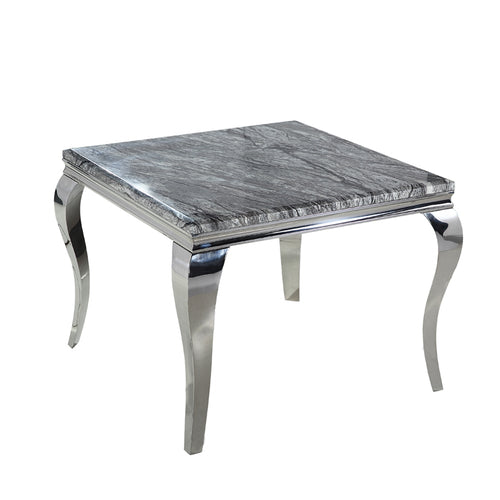
There's a social quality to a square table too, one it shares with round tables: no head position, everyone facing each other across a surface that's the same distance in every direction. At four seats it's a particularly natural arrangement, with one person on each side and no one marooned at an end. For a household where daily meals are the priority and the dining table is genuinely used for sitting together rather than just occupying the room, that quality is worth something. Our square dining tables sit within our wider dining tables collection and are available in a range of sizes and surface materials, sold as standalone tables to pair with dining chairs of your choosing, or as part of a matched combination in our square dining sets collection if you'd prefer chairs included.
Finance is available on many of our dining tables, subject to status. We deliver nationally across the UK, and our Manchester showroom is open if you'd like to see square tables in person before you order.

What's in this collection

Square dining tables are available in a range of sizes, from compact options suited to a small kitchen-diner through to larger configurations for a household that eats together regularly and has the room to hold a more substantial piece. Surface materials across the collection include ceramic and stone-effect tops, glass dining tables options, marble dining tables configurations, and other finishes. Base and leg designs vary from four corner legs to pedestal styles, with frame finishes spanning contemporary metal options including chrome and gold among others.

Our square dining sets collection is worth browsing alongside this page if you want the table and chairs as a matched combination. If you're choosing the table independently and pairing it with chairs of your own choosing, you're in the right place here.

When a square dining table works best

The room shape is the most reliable starting point, as it is for any table shape decision. A square room, or one that's close to it, suits a square table for the same reason a rectangular room suits a rectangular one: the proportions align, the clearance falls naturally on all sides, and the floor space is used well without dead zones at the ends or awkward gaps on the sides. If you measure your dining area and find it's roughly as wide as it is long, a square table is worth putting into the floor plan before you assume you need rectangular.

Open-plan kitchen-diners present a version of the same question. In a larger open-plan space, the dining area is often defined by the furniture itself rather than by four walls, and a square table can anchor that zone more naturally than a rectangular one. A long rectangular table in a wide open-plan room can feel like it's pointing somewhere rather than sitting within a space. A square table reads as contained and purposeful, which gives the dining area a stronger sense of being a proper part of the room rather than an afterthought at one end of the kitchen.

The practical advantage that often gets mentioned last but matters a lot in a working household is the option to push a square table against a wall when it's not in use. One side flush against the wall, the remaining three sides accessible, and suddenly a compact dining area has considerably more floor space for the rest of the day. For a small kitchen-diner where the table needs to function alongside everything else the room does, that flexibility is worth planning for. The same move with a rectangular table works, but a square table pushed into a corner with two sides against the walls can free up floor space more efficiently still.

A square table is at its most natural at four seats: one person on each side, equal spacing, everyone facing everyone else. At six seats the arrangement shifts: two people share one or two of the sides and the table needs to be wide enough in both directions to seat two side by side comfortably. At that scale, the room requirements in both directions become more demanding, because a square table that seats six is a genuinely large piece of furniture in every dimension rather than just in its longest one.

Where a square table is a harder fit is in a clearly elongated room. A long narrow dining room, a through-room in a terraced house, or a galley kitchen-diner where the dining area is defined by its length gives a square table nowhere to go: the length of the room is wasted, and the table sits awkwardly with too much space at either end and too little on the sides. In those rooms a rectangle dining tables page is the more appropriate starting point. For rooms that sit somewhere in between, it's worth doing the floor plan exercise with both shapes and seeing which gives you better clearance and a more natural relationship to the walls before you decide.

Sizes in our square dining tables

The size of a square table is its measurement in one direction, which applies equally in both. This symmetry is part of what makes square tables suit square rooms, but it also means the room needs to hold the same dimension in both directions with proper clearance applied.

The standard clearance guidance is around 90cm between the edge of the table and the nearest wall or obstacle on all sides. For a square table, apply that in both directions to find the maximum table size the room will hold comfortably. A dining area that is 3.5m in one direction and 3.5m in the other can hold a table up to around 1.7m square with proper clearance all round. In practice, most square dining tables sit at more modest dimensions, and a table between 1.2m and 1.5m square is the most common range for a family household.

At the smaller end, a table around 1.1m square seats two to four people and suits a compact kitchen-diner where floor space is genuinely limited. At 1.2m to 1.3m, four seats sit comfortably with reasonable elbow room and a fifth person can be accommodated on occasion. At 1.5m square, six seats become realistic, though the room needs to hold that dimension with full clearance in both directions, which is a more significant ask than it sounds.

The size pages linked above cover the specific room requirements for each length in detail. If you'd like to check a specific size against your room before ordering, share your dimensions with us and we'll work through what fits.

Materials in our square dining tables

The material considerations for a square dining table are the same as for any dining table, and each material page covers the specifics. A few notes on how different materials read in the context of a square table.

Ceramic dining tables in square form are the most practical choice for a family using the table every day. Non-porous, heat-resistant, and easy to wipe down, ceramic holds up to daily use without the maintenance demands of real marble. Available in stone-effect and marble-look finishes that work in both contemporary and transitional interiors.

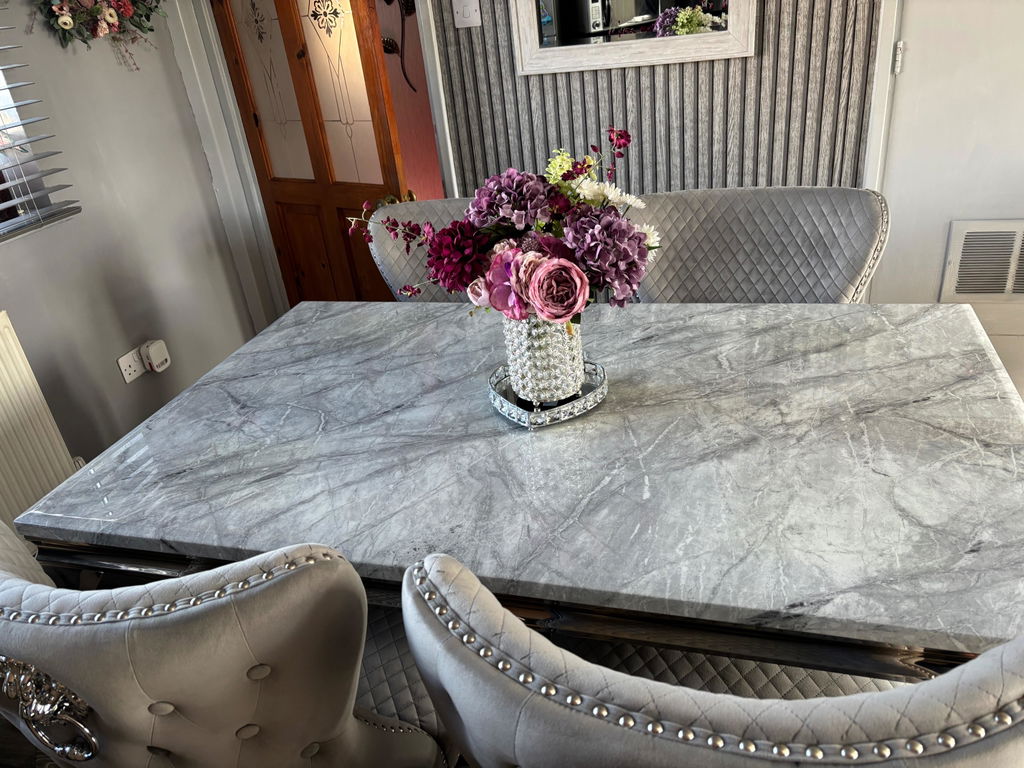
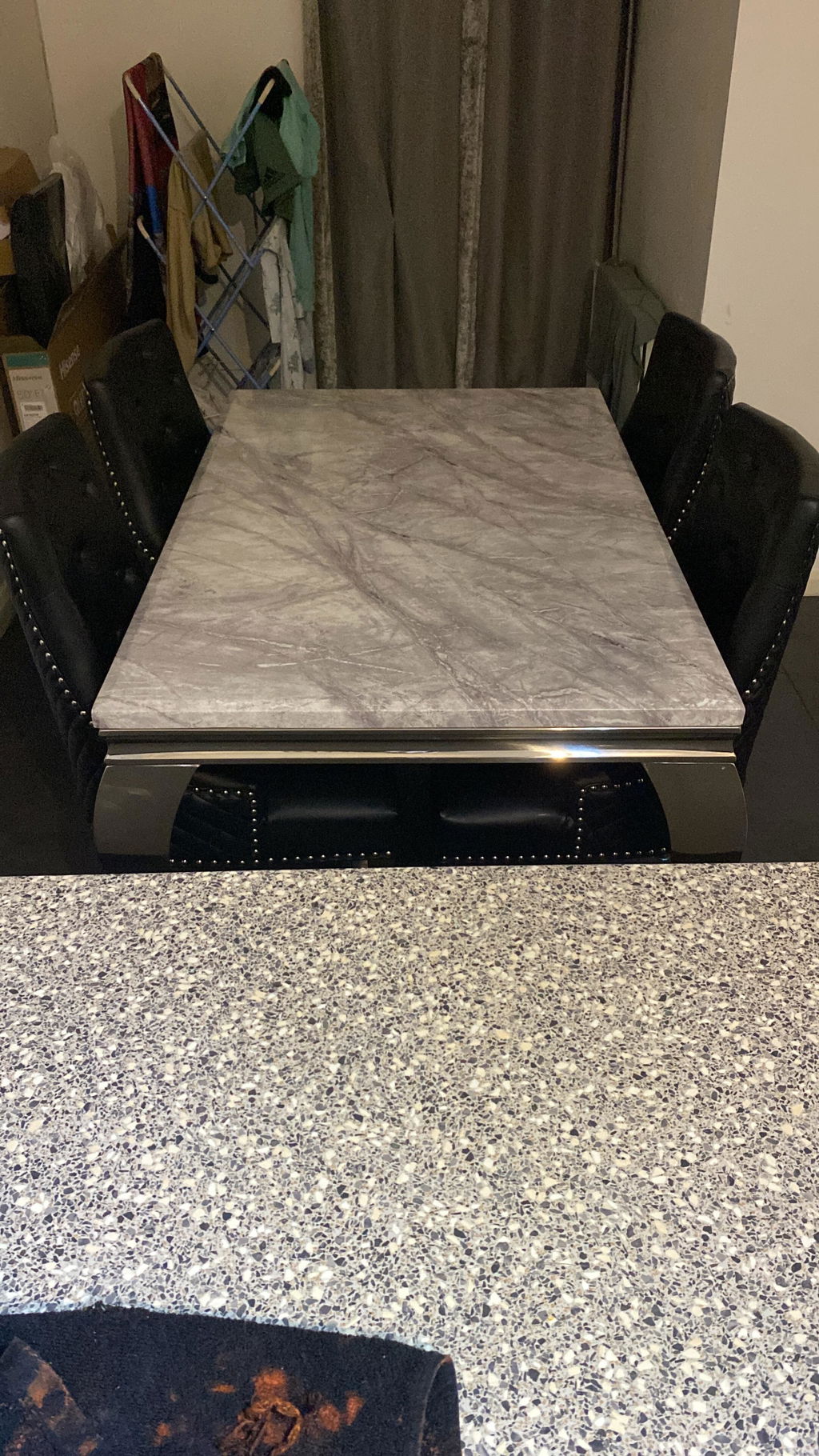
Marble dining tables in square configurations make a strong visual impression because the full surface is on show without the length of a rectangular table drawing the eye along it. A marble square table in a properly furnished dining room is a confident choice. The care requirements for real marble, sealing, heat protection, prompt attention to acidic spills, apply regardless of shape. Marble-effect ceramic is the more practical option where the look matters but the maintenance commitment doesn't suit the household.

Glass dining tables in square form are particularly effective in smaller rooms because the transparency of the top works in both directions equally. In a compact square kitchen-diner, a glass square table keeps the room feeling open without the surface claiming the visual space the way a solid top would. The cleaning commitment is the same as for any glass surface: marks and smears are clearly visible and the table needs a proper wipe-down after most meals.

Gold dining tables and chrome dining tables refer primarily to the base and leg finish rather than the top surface. Both are available in square configurations and pair naturally with ceramic, glass, or stone-effect tops depending on the look you're going for and the interior the table is going into. Gold suits rooms with warmth and depth; chrome suits cleaner and more contemporary settings.

Spreading the Cost

Finance is available on many of our dining tables, subject to status. If the table you want is above your immediate budget, spreading the cost is worth exploring. We're happy to talk through the options at any point.

Why buy from Shawcross

We're based in Manchester and our showroom is open if you'd like to see square dining tables before buying. Proportion and scale are the things a product page finds hardest to convey, and for a square table in particular, seeing the dimensions in a real space with chairs around it gives a more reliable sense of whether the size is right than any photograph can. It also gives you the opportunity to see how the table surface reads in natural light alongside the chairs you're considering.

We deliver nationally across the UK, and you can contact us at any stage for guidance on sizing, room fit, material, or chair compatibility before you order. If you're deciding between a square and another shape and want an honest view on which will work in your specific room, that's exactly the kind of thing we're happy to help with.


Square Dining Table FAQs

What size room do I need for a square dining table?

The calculation is the same in both directions, which is the key difference from planning around a rectangular table. Take the available floor space in both dimensions, subtract 90cm clearance on each side, and the maximum table size follows from the smaller of those two results.

For a concrete example: a dining area that is 3.5m wide and 3.8m long can hold a square table up to around 1.7m in its smaller dimension with proper clearance. Because the table is square, the limiting dimension is the 3.5m width: 3.5m minus 90cm on each side leaves 1.7m of usable table dimension. The extra length of the room beyond what the table uses is simply not a factor.

In most homes the dining area is somewhere between 2.8m and 4m in its smaller dimension, which means square tables between 1m and 2.2m can be accommodated in various rooms depending on the specific measurements. For most family households a table between 1.2m and 1.5m square is the practical range, requiring a room of at least 3m to 3.3m in its smaller dimension with proper clearance.

If you'd like a direct answer on what works in your specific room rather than working through the calculation yourself, share your dimensions with us and we'll tell you.

How many people does a square dining table seat?

At its most natural, a square table seats one person per side, which gives four seats with generous elbow room and a comfortable conversational arrangement where everyone faces everyone else directly. This is the most common configuration and the one most square tables are sized around.

Six seats are achievable by placing two people on two of the four sides. For this to be comfortable rather than just technically possible, the two shared sides need to be long enough: two people side by side need around 1.2m of table length between them to have proper elbow room. A square table that seats six on two sides therefore needs to be at least 1.2m in both directions, and ideally closer to 1.4m to allow proper spacing.

Eight seats at a square table are possible in principle, with two people per side, but requires a table large enough to hold eight adults comfortably, which is a very large piece of furniture in both directions and needs a room that can hold it with clearance equally in every direction. For most households needing eight seats, a rectangular table is a more practical route.

What's the difference between a square and a round table for a smaller room?

Both shapes suit squarish rooms and share the social quality of having no head-of-table position. The differences between them are practical rather than aesthetic in most cases.

A round dining table has no corners, which makes movement around it easier and removes the hard corner at hip height that young children reliably find in any room. At the same seating count, a round table often has a slightly smaller overall footprint than a square one because a circle uses less area than a square of the same internal diameter. In a very small room, that difference in footprint can matter.

A square table has corners, which some households find useful: the table can be pushed flush against a wall or into a corner when not in use, freeing up floor space during the day. At a wall, two seats remain accessible on the two open sides; in a corner, two sides sit against the walls and two remain accessible. That flexibility is harder to achieve with a round table.

The choice often comes down to the room's relationship to the furniture when it's not being used for meals. If the table needs to step back during the day, a square table pushed to a wall works better. If the room is used primarily as a dining room and the table is always out in the same position, both shapes are equally practical and the decision becomes one of preference.

Can a square dining table be pushed against a wall?

Yes, and this is one of the practical advantages of a square table over a round one in a compact room. One side against the wall frees up the floor space that would otherwise be clearance on that side, and people can still sit on the three remaining sides. In a kitchen-diner where the dining area also needs to function as a kitchen, getting the table out of the way during cooking without moving it entirely is a useful option.

Two sides against a corner works similarly, with two sides accessible and the table sitting neatly in the corner of the room. At a table for four, that arrangement leaves two seats comfortably accessible on the two open sides, and a third chair can often be pulled up to one of the open sides on occasion.

The thing to be aware of is chair clearance against the wall. The person sitting closest to the wall needs to be able to pull their chair out far enough to sit down comfortably. If the wall side is very close to the table edge in its pushed-back position, that clearance may not be there. It's worth testing the arrangement in the room before you settle on it as a permanent configuration.

What materials are available in square dining tables?

The same range of surface materials available across our dining tables collection is represented in square configurations, including ceramic and stone-effect tops, real marble and marble-effect finishes, and glass. Base finishes include chrome, gold, and other options depending on the specific table.

One material note that applies specifically to square tables: the full surface is on show equally in every direction, which means the surface quality and finish are visible from every seat around the table. On a rectangular table, the ends and the middle of the table are seen from different angles and distances; on a square table, everyone is roughly the same distance from every part of the surface. This makes the material choice feel more prominent, and for a surface like marble or ceramic with genuine pattern and variation, it's worth seeing the specific table in person before you buy rather than relying on product photographs that may not show the full surface character.

How does delivery work, and can I see square dining tables in person first?

We deliver nationally across the UK. Once your order is placed you'll receive a confirmation, and we'll be in touch closer to the time to arrange a delivery date that suits you. Delivery for dining tables is typically within 28 days. If there's anything about your property worth knowing in advance, such as a narrow hallway, a tight corner on the route to the dining room, or restricted parking, let us know when you order so the delivery team can prepare.

If you'd prefer to see square dining tables in person before you commit, our Manchester showroom is open and you're welcome to come in without any obligation. Proportion and scale are genuinely hard to judge from a product page, and seeing a square table in a real space with chairs around it makes for a considerably more confident decision. If you'd like to confirm whether a specific piece is currently on the showroom floor before travelling, just give us a call.