Skip to content

Cinema Sofas

Most living rooms have a sofa that happens to face the TV. A cinema sofa is different: it's built around the idea of watching properly. The seats...

Most living rooms have a sofa that happens to face the TV. A cinema sofa is different: it's built around the idea of watching properly. The seats are deeper, the backs are higher, and the whole configuration is designed to keep everyone comfortable over two hours without anyone shifting around or folding up to one side. If your household watches a lot and the sofa you're on isn't doing the job, that's the gap this kind of sofa fills.

The cinema sofas here come in a range of configurations and sizes, from standalone 2 and 3-seaters through to large corner and U-shape setups that wrap around a room. The material options span fabric, leather, faux leather, velvet and boucle, and some models include built-in features like cup holders and USB charging ports. If you're still deciding between this and a more general-purpose sofa, the full sofas collection is a useful starting point for comparison.

Finance is available on many of the sofas here, subject to status. We deliver across the UK, with sofas typically arriving within 28 days. If you'd like to try any of these in person before you commit to something this size, you're welcome at our Manchester showroom.

What's in this collection

Cinema sofas cover a wider range of configurations than most sofa categories, so it's worth understanding what's available before you browse.

The smaller-format options are standalone 2 and 3-seaters, and 3+2 sets, designed with the proportions and seating posture of a cinema sofa but in a footprint that suits a conventional living room. They sit deeper and recline more generously than a standard sofa, which is what sets them apart. They work well in a room where the sofa faces a TV wall and screen-watching is the main use.

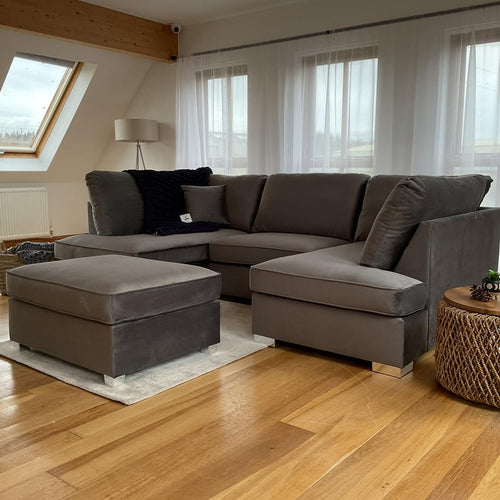
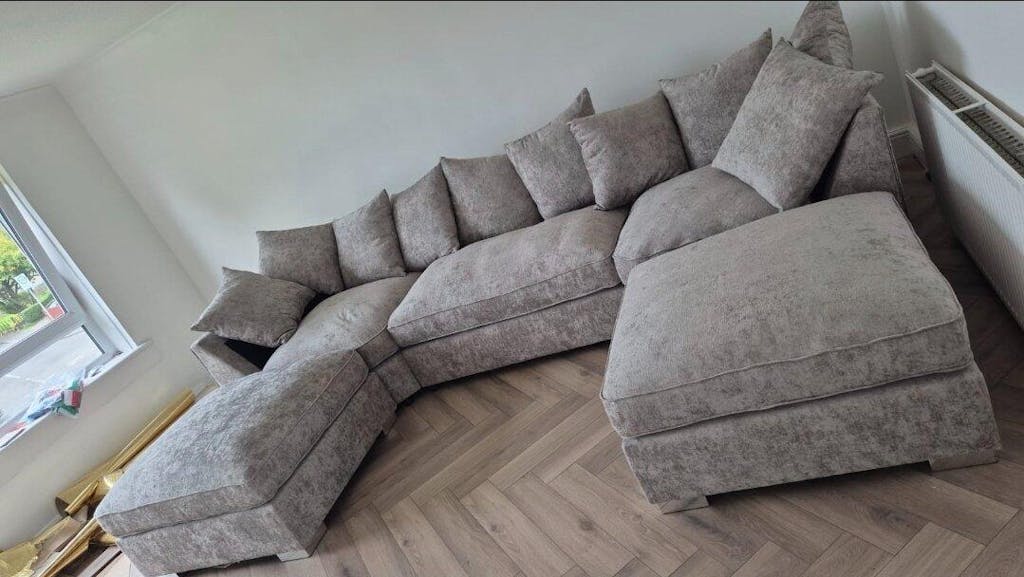
The corner and U-shape configurations are a step up in scale and ambition. These are the sofas that define a room. A well-chosen corner cinema sofa, positioned at the right angle to the screen, can make a living room feel genuinely purpose-built for watching. Some models in this section include built-in features: cup holders in the arm or central console, USB charging ports, and in some cases LED underlighting. These aren't gimmicks in the context of a sofa that's designed specifically for this kind of use.

The L-shape chaise options are somewhere between the two, offering a corner element without the full wrap-around scale of a U-shape. They suit rooms where a full corner sofa would be too much but a straight sofa doesn't quite make the most of the space.

Is a cinema sofa right for your room?

The honest answer to this depends on how the room is actually used. A cinema sofa is designed around one activity, and it does that activity very well. But it's a more specific piece than a general-purpose sofa, and it's worth thinking through before you commit.

If the room is primarily a TV room and the sofa spends most of its life facing a screen, a cinema sofa will be noticeably better for the job than a conventional sofa. The seating positions are more reclined by design, the depth gives you room to stretch out, and the configurations, particularly the corner and U-shapes, are laid out to give everyone a good viewing angle rather than leaving whoever is on the end straining to see past the person next to them.

If the room serves multiple purposes, if it's also where people sit and talk, work from occasionally, or where children do their homework, the more dedicated posture of a cinema sofa can feel limiting for those other uses. A general-purpose sofa from the fabric sofas or leather sofas ranges might serve the household better overall. Neither is the wrong answer. It comes down to what the room is actually for.

Choosing the right size and configuration

The corner and U-shape cinema sofas in this collection are large pieces, and planning the room properly before you order is essential rather than optional.

For a corner sofa, you need two walls long enough to take each arm of the sofa with comfortable clearance. The corner itself anchors the piece, but the legs need room to extend along each wall without blocking doorways or radiators. Mark out the footprint on the floor before you order.

U-shape sofas are the largest option here and command a room in a way that's difficult to reverse once the sofa is in. They suit open-plan spaces and larger dedicated media rooms well. In a typical family living room, a U-shape can work, but it will dominate the space. Make sure the room genuinely suits it before committing. Measure the full width and depth of the U from outer edge to outer edge, then check that there's enough clear floor in the centre for a coffee table or viewing space between the sofa and the screen.

For any sofa in this collection, door widths and access routes are worth checking in advance. The larger configurations come in sections, which makes delivery easier, but it's still worth walking the route from your front door to the room and noting any tight turns or narrow doorframes. Get in touch if you'd like to think through the access before ordering.

Materials: what to consider for a sofa used heavily

A sofa that sees daily heavy use accumulates spills, snacks and general wear faster than almost any other piece of furniture in the house, so the material choice is genuinely practical rather than just aesthetic.

Fabric is warm and comfortable and suits the relaxed, settled feeling a cinema sofa is aiming for. The trade-off is cleaning: fabric absorbs spills more readily than a smooth surface, and significant marks can be harder to shift thoroughly. Regular vacuuming keeps it looking decent between deeper cleans.

Leather and faux leather are considerably easier to wipe down after a spill, which in a room used for eating and drinking regularly is a meaningful advantage. Faux leather performs similarly to real leather in everyday use and is the more accessible choice in terms of cost. Real leather has a different feel and tends to age in a way some people find attractive. Both feel slightly cooler initially than fabric, which is worth knowing.

Velvet and boucle sit at the more aesthetic end of the choices here. Both look rich and feel good to sit in, and they work well in a room where the sofa is as much a design choice as a practical one. The honest caveat is that both require more care than fabric or smooth-surface options, and neither is the easiest choice in a household with young children or pets. If that's the context, fabric or faux leather will give you fewer headaches.

Spreading the cost

Cinema sofas, particularly the larger corner and U-shape configurations, represent a significant spend. Finance is available on many of the sofas in this collection, subject to status, which means you can spread the cost over a period that works for your budget rather than paying everything upfront. Check the finance page for details, or ask us directly when you get in touch.

Why buy from Shawcross

We're a Manchester-based retailer and the showroom carries a selection of sofas you can sit in before you decide. For a cinema sofa especially, that matters. The whole premise of this kind of sofa is that it's more comfortable to watch in than a standard sofa, and the only reliable way to know whether a specific sofa delivers on that for you is to sit in it. Seat depth, back height, the angle of the recline: none of that comes through clearly in a product image.

For customers elsewhere, we deliver nationally across the UK within 28 days. We're happy to help at any stage before you order, whether that's talking through room dimensions, comparing configurations, or working out whether a corner cinema sofa or a straight model better suits your space.


Cinema Sofa FAQs

What actually makes a cinema sofa different from a regular sofa?

The differences are about posture and purpose. A standard sofa is designed for an upright sitting position, which works well for conversation and general use but isn't the most comfortable position for watching a screen for two hours. A cinema sofa is designed with a deeper seat, a more reclined back angle, and in many cases a higher back to properly support your head and neck when you're settled in for a long watch.

The configuration choices also tend to be more screen-focused. Corner and U-shape layouts position everyone at a good viewing angle rather than leaving the person at one end sideways to the screen. Some models include practical features built into the design, such as cup holders or USB charging, that are specifically useful in a sofa used for sitting and watching over longer periods. None of these things make a cinema sofa universally better than a conventional sofa; they make it better for a specific use. In a room where that use is the main one, the difference is noticeable.

How do I know if my room is big enough for a corner cinema sofa?

The key measurements are the two walls the sofa will sit against. Each arm of a corner sofa needs enough wall length to extend comfortably without blocking a door, a radiator, or another piece of furniture. Start by measuring both walls from the corner out to the first obstruction. Then check the dimensions of the sofa itself, including the depth, which tells you how far it will project into the room.

A corner sofa needs clear floor space in front of it for comfortable seating, and for the TV to be at a workable distance and height from the sofa. As a rough starting point, the screen should typically be between two and four metres from the seats, depending on its size. If the room is shorter than that, the viewing distance can feel uncomfortably close even if the sofa physically fits. Mark the sofa's footprint on the floor with tape and sit in a chair within that outline to check the sightline before you order. If you'd like to run your room dimensions past us, we're happy to give you a view on what will work.

Can a cinema sofa work in a regular family living room, or is it only for dedicated media rooms?

It works well in a regular living room, provided the room is primarily used for watching rather than for conversation, games, or other activities where you want a more upright sitting posture. Many households have a living room that's essentially a TV room in practice, and a cinema sofa suits that use far better than a conventional one.

The caveat is versatility. A deep, reclined cinema sofa is excellent for its intended purpose and less comfortable for sitting upright to eat, do homework, or have a conversation at eye level. If the room serves genuinely mixed purposes, a more general-purpose sofa will be more flexible across all of them. It's worth being honest about how the room actually gets used day to day before deciding. For households where the answer is mostly watching, a cinema sofa is a straightforward upgrade.

What's the difference between a corner, U-shape and L-shape cinema sofa?

A corner sofa has two straight arms meeting at a corner section, running along two walls. It's the most common large-format sofa configuration and suits a wide range of rooms. The seating runs along both legs, and the corner seat itself often has the most legroom.

A U-shape sofa extends a third section, so the seating wraps around on three sides. It creates a more enclosed, immersive feel and provides more total seating than a corner, but it occupies considerably more floor space and works best in larger rooms or open-plan spaces. It's the configuration that most closely mimics a home cinema setup, with everyone sitting within the same enclosed area facing the screen.

An L-shape or chaise configuration is smaller in scale: one arm extends into a longer chaise section rather than turning a full corner. It's a middle ground option that suits rooms where a full corner would be too large but a straight sofa doesn't quite fill the space or give enough room to lie out.

If you're unsure which suits your room, come into the Manchester showroom where we have larger sofa configurations on the floor, or get in touch with your room dimensions and we can advise.

Are the built-in features like cup holders and USB ports useful or just a novelty?

Genuinely useful in the right context. On a sofa used primarily for watching films and TV, a cup holder in the armrest or central console is a practical feature: it keeps drinks secure without needing a coffee table within arm's reach, and it reduces the risk of spills on the sofa itself. For households where the sofa sees a lot of film nights, it earns its keep quickly.

USB charging ports built into the frame mean you don't need to stretch to a plug socket behind the sofa or leave a cable across the floor. Again, in a room where people spend long periods on the sofa with a phone or tablet, that's more useful than it might seem from a spec list.

These features add to the cost compared to a sofa without them, and they're not worth paying for if the sofa is going to be used for general sitting as much as watching. But for a household that genuinely uses the sofa as their primary viewing space, they're the right extras to have. If you're not sure whether a specific model includes them, get in touch and we can confirm.

How does delivery work for a large corner or U-shape cinema sofa?

Larger configurations are delivered in sections, which makes getting them through doorways and into the room more manageable than trying to manoeuvre one continuous piece. That said, it's still worth measuring the access route from your front door to the room before delivery day. Note the width of the front door, the hallway, any internal doorframes, and any corners or stairs along the route.

Sofas are typically delivered within 28 days. You'll receive confirmation after ordering and a delivery date closer to the time. If your property has any access challenges, let us know when you order so the delivery team can prepare. Assembly of multi-section sofas is usually straightforward, but if you'd like assistance with that, ask us about assembly options when you get in touch.