Skip to content

1.6m Dining Tables

The difference between a 1.5m and a 1.6m dining table is 10 centimetres. On paper that sounds modest, and the room planning implications of those 1...
The difference between a 1.5m and a 1.6m dining table is 10 centimetres. On paper that sounds modest, and the room planning implications of those 10 centimetres are modest too: a room that holds a 1.5m table with proper clearance will almost always hold a 1.6m table with the same clearance, because the additional length is small enough that the clearance calculation rarely changes the outcome. What changes is the experience of sitting at the table. Six people at a 1.5m table are comfortable. Six people at a 1.6m table have noticeably more elbow room, and the table doesn't feel at capacity in the way a 1.5m sometimes does when every seat is filled. For a household that eats as six regularly rather than occasionally, that difference is worth the 10 centimetres.
Our 1.6m dining tables sit within our wider dining tables collection and are available in a range of surface materials and base styles. Tables here are sold as standalone pieces to pair with dining chairs of your own choosing. If you'd prefer a matched table and chair combination, our dining sets collection includes sets at this size.
Finance is available on many of our dining tables, subject to status. We deliver nationally across the UK, and our Manchester showroom is open if you'd like to see tables in person before ordering. If you're deciding between 1.6m and an adjacent size, get in touch and we'll work through the specifics with you.

This collection is empty

View all products

What's in this collection

A 1.6m dining table is a rectangular table measuring 1.6 metres in length, available in a range of surface materials and base designs. The table sits at the upper end of the standard family dining room range: large enough to seat six with real comfort and to seat eight on occasion, but not so large that it needs a dedicated dining room to carry it properly.

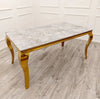
Surface materials across the collection include ceramic and stone-effect tops, real marble and marble-effect finishes, and glass, with base and frame options spanning contemporary metal designs in chrome, gold, and darker finishes. Both fixed and extending configurations are available: a fixed 1.6m table permanently occupies that footprint, while some extending tables reach 1.6m from a smaller standard size, giving you flexibility if your everyday seating need is smaller than six.

What a 1.6m dining table needs from the room

A 1.6m table suits a room with a proper dining area rather than a compact kitchen-diner. It's not as demanding as a 1.8m table in terms of the room it requires, but it does need more floor space than a 1.5m, and the clearance calculation is worth doing properly before you commit.

Apply 90cm of clearance on all four sides as the working minimum. A 1.6m table is typically around 90cm wide. With 90cm clearance on all sides, the minimum room required is approximately 3.4m in length and 2.7m in width. These are minimum figures for a room used specifically as a dining room, with nothing else requiring floor space between the table and the walls. In a room where a sideboard or dresser sits along one wall, subtract the depth of that piece from the available length before you apply the clearance. The usable floor space in a furnished dining room is often smaller than the wall-to-wall dimensions suggest.

The 10cm difference between a 1.5m and 1.6m table means the room requirements are very similar. If your room sits at the borderline between the two sizes, a 1.5m dining table might give you marginally more comfortable clearance while still seating four to six. If the room can hold 1.6m with proper clearance, the additional elbow room for six people is a worthwhile gain. It's the kind of decision that's settled quickly with a tape measure rather than slowly with guesswork.

Access to your property on delivery is worth thinking through in advance. A 1.6m table needs a clear route from the front door to the dining room, and a narrow hallway, a tight corner, or stairs between the two are worth flagging when you order. Most tables at this size are manageable on delivery, but knowing about any constraints in advance means the team can prepare rather than problem-solve on the day.

Materials at 1.6m

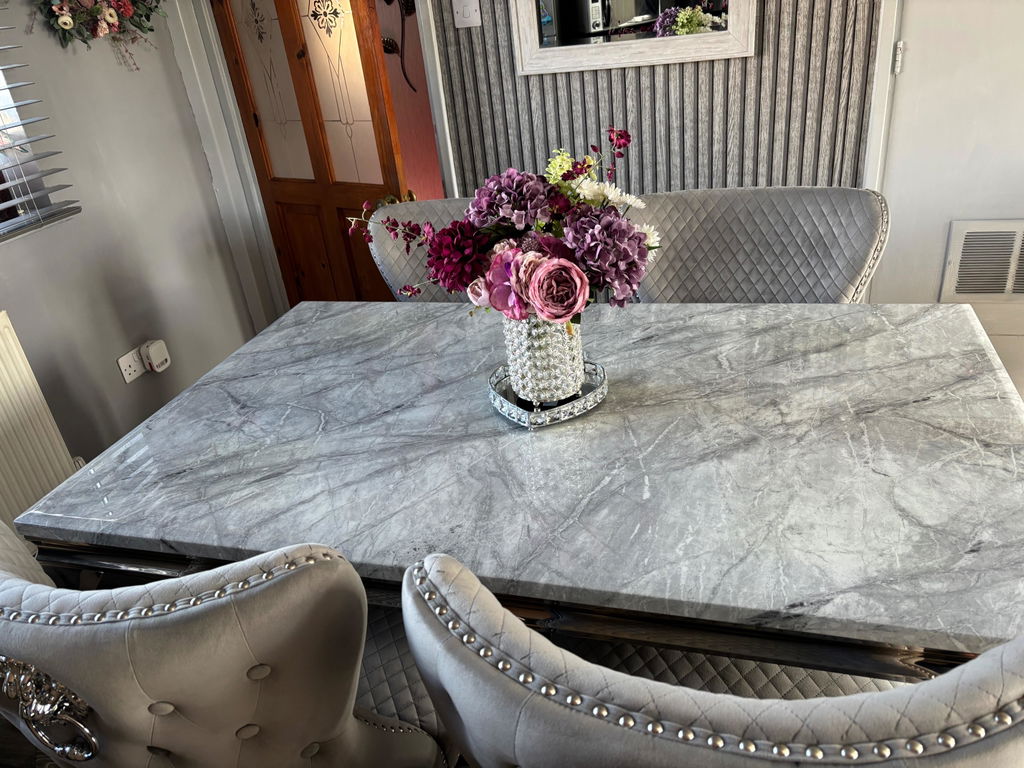
Ceramic dining tables at 1.6m are the most practical choice for a family table used regularly. The non-porous, heat-resistant surface handles everything a busy dining room puts it through without any specialist products or periodic treatment. Stone-effect and marble-look ceramic finishes have genuine visual presence at this length, and for a household that wants the look of stone without the maintenance commitment of real stone, ceramic at 1.6m is the combination most likely to satisfy both requirements.

Marble dining tables at 1.6m are a considered choice for a dining room where the table is the centrepiece and the aesthetic investment is part of the brief. A 1.6m marble surface has enough length to show the full character of the stone, the veining, the tonal variation, in a way that a more compact table doesn't always achieve. The care requirements for real marble apply at this size as at any other, and the marble dining tables page covers those in detail. Marble-effect ceramic is the practical alternative where the aesthetic is the goal but the maintenance commitment doesn't suit the household.

Glass dining tables at 1.6m keep the room feeling open despite the table's length. In a dining room that is adequate in size but not generous, a glass top prevents the table from dominating the space in the way a solid surface of the same dimensions would. The cleaning commitment applies in full: a 1.6m glass surface shows every mark after a meal and needs a proper wipe-down rather than a quick pass to look clean. For a room used mainly for entertaining rather than every evening by a busy family, that trade-off works more comfortably.

Chrome dining tables and gold dining tables refer to the base and frame finish. Both are available at 1.6m. Chrome suits contemporary rooms with a clean, modern interior; gold suits rooms with warmth and depth in the palette and is particularly effective alongside marble-effect or stone-effect ceramic tops. Each material page covers those frame finishes in detail if you want to understand them fully before deciding.

Spreading the Cost

Finance is available on many of our dining tables, subject to status. If the table you want sits above your immediate budget, spreading the cost is worth exploring. We're happy to talk through the options at any point.

Why buy from Shawcross

We're based in Manchester and our showroom is open if you'd like to see dining tables in person before buying. For a size decision that comes down to 10 centimetres between two options, seeing the lengths side by side in a real space makes the comparison considerably more intuitive than working from dimensions alone. Surface quality in natural light is also worth assessing in person, particularly for marble and ceramic finishes where the character of the surface isn't reliably conveyed in product photography.

We deliver nationally across the UK, and you can contact us at any stage for guidance on room fit, material, or which size is genuinely right for your household before you order.


1.6m Dining table FAQs

How many people does a 1.6m dining table seat?

Six people sit comfortably along the two long sides of a 1.6m table, with three on each side and around 60cm per person. That's a generous allowance for a full meal: three adults on each side with proper elbow room rather than the slightly cosy arrangement that six people at a 1.5m table sometimes produces. For a household that eats as six regularly, either as a family or with frequent guests, the 1.6m is the size that handles that count without anyone feeling squeezed.

Eight seats are achievable by placing one person at each short end. The end positions on a 1.6m table are practical seats rather than overflow arrangements: the table is long enough that the end chairs don't encroach uncomfortably on the corner seats. Eight at 1.6m is a workable dinner party configuration rather than a special occasion compromise.

Four people at a 1.6m table have generous space, and if four is the everyday count with six being occasional, the 1.6m works very comfortably for both. The table doesn't feel oversized with four people at it in the way that a 1.8m might.

What's the practical difference between a 1.5m and a 1.6m dining table?

At four seats, the difference is barely noticeable. Both sizes seat four with good elbow room, and in everyday family use at four the 10cm is not something you'll feel at the table.

At six seats, the difference is real. Six people at a 1.5m table are comfortable but relatively snug: around 55cm per person, which works fine but doesn't leave much margin. Six people at a 1.6m table have closer to 60cm each, which is the difference between a meal that feels like everyone fits and a meal where everyone has proper room. If six is a regular count rather than an occasional one, that experience compounds across every meal and the 1.6m earns its keep.

The room planning implications are modest. The 10cm difference in table length translates to 10cm of additional room required in the longest direction once clearance is applied. For most rooms that can hold a 1.5m table, 1.6m is also viable without the room feeling meaningfully tighter. The decision is almost always more about the seating experience than about the room constraint, and that's the right way to think about it.

What room size do I need for a 1.6m dining table?

With 90cm clearance on all four sides, a 1.6m table needs a minimum room of approximately 3.4m in length and 2.7m in width. That's a standard dining room size and most rooms designated as dining rooms will meet it.

In practice the more useful check is whether the specific room you're working with holds those dimensions in the floor area that's actually available for the table, accounting for any perimeter furniture. A room that measures 3.4m wall to wall but has a radiator on one wall and a doorway opposite it has a usable length closer to 3.2m once those obstacles are subtracted from the available clearance. It's worth measuring the actual usable floor space rather than the room dimensions.

If you're unsure whether your room is comfortably on the right side of the minimum, share your measurements with us. We can tell you whether a 1.6m table works with proper clearance or whether a 1.5m dining table would give you more comfort in that specific space.

Should I go to 1.8m instead of 1.6m?

The right question is what the table will actually be used for most of the time, and whether the room can hold a 1.8m dining table properly rather than technically.

If you regularly eat as a household of six and occasionally need eight seats for guests, 1.6m is likely the right choice. The table handles six comfortably as its primary purpose and seats eight when needed without requiring a larger room than most standard dining rooms provide. The step to 1.8m at that usage pattern is buying more table than the household consistently needs.

If you regularly eat as seven or eight, or if you have a dining room with genuine length and you want a table that makes full use of it, 1.8m is worth looking at seriously. The seating experience at eight across 1.8m is noticeably more comfortable than at eight across 1.6m, and for a household where that count is the norm rather than the exception, the step up is justified by how the table is actually used.

The room is the constraint that sets the limit, and the household usage is what determines where within that limit the right size sits. If you'd like a direct view on which suits your specific situation, we're happy to talk it through.

Can a 1.6m table extend to seat more people?

Some tables in the collection are extending designs that sit at a smaller standard size and open out to 1.6m. If the table you're considering is itself an extending design, the extended dimensions are 1.6m and those are the dimensions to plan the room around, because that's when the most people are seated and movement around the table matters most.

A fixed 1.6m table doesn't extend, but placing a chair at each short end adds two seats to the standard six-seat configuration and brings the count to eight. Whether that works comfortably depends on the specific table: the end seats need enough clearance from the corner chairs to allow everyone to sit without feeling squeezed, and it's worth checking the table dimensions confirm that before you treat end seats as a reliable option.

For households who want a table that genuinely extends beyond eight seats, our extending dining tables page covers the full extending range and is worth browsing if that flexibility is something you're looking for.

How does delivery work, and can I see 1.6m dining tables in person first?

We deliver nationally across the UK. Once your order is placed you'll receive a confirmation, and we'll be in touch closer to the time to arrange a delivery date that suits you. Delivery for dining tables is typically within 28 days. If there's anything about your property worth knowing in advance, such as a narrow hallway, a tight corner on the route to the dining room, or restricted parking, let us know when you order so the delivery team can prepare.

If you'd prefer to see 1.6m dining tables in person before you commit, our Manchester showroom is open and you're welcome to come in without any obligation. If you're deciding between 1.6m and an adjacent size, seeing both lengths in the showroom is the most efficient way to make that comparison: the difference between 1.5m and 1.6m is subtle on a tape measure and more apparent in real space with chairs around the table. Surface quality in natural light is also worth seeing before you decide on a specific material. If you'd like to confirm whether a specific piece is currently on the showroom floor before travelling, just give us a call.