What's in this collection
Round dining tables are available in a range of diameters and surface materials, with base styles that vary from central pedestal designs to four-leg configurations. The base type has a practical effect on the seating arrangement as well as the visual character of the table: a pedestal base removes corner legs entirely, which gives more flexibility on chair positioning and makes it easier to squeeze in an extra person on occasion. A four-leg base positions the legs at the outer edge of the table, which is stable and straightforward but does mean the leg placement needs consideration when you're working out seating positions.
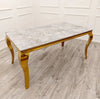
Surface materials across the collection include ceramic and stone-effect tops, marble dining tables configurations, glass dining tables options, and other finishes. Each material has its own character and its own maintenance requirements, covered in detail on the relevant material pages. The base and frame finishes span contemporary metal options including chrome and gold, and other styles to suit different interiors.
When a round dining table is the right choice
The room shape is the most reliable guide. Square and near-square rooms suit round tables well because the equal dimensions in both directions align naturally with the equal radius of the table. The clearance falls on all sides without the dead space at the ends that a rectangular table creates in that kind of room. If your room is roughly as wide as it is long, a round table is worth trying in your floor plan before assuming you need rectangular.
Open-plan spaces present a slightly different argument. In a kitchen-diner where the dining area isn't defined by four walls but by its relationship to the kitchen and the living space around it, a round table tends to feel anchored and self-contained in a way a rectangular one sometimes doesn't. It reads as a gathering point rather than a piece of furniture that points in a direction. That quality is partly aesthetic and partly practical: the absence of corners means movement around the table is easier in a space where people are also moving between the kitchen and the rest of the room.
The social dynamic is something a lot of people mention after living with a round table for a while. Without a head position, the table arrangement is inherently equal: everyone has roughly the same amount of space, faces roughly the same direction relative to everyone else, and is at a similar conversational distance from the others. At four to six seats, that makes for an easy and natural meal. It's a different quality from the arrangement at a rectangular table, and for a lot of households it's a better one.
One practical point that's easy to overlook: round tables have no corners. In a room where people are moving around the table regularly, or in a household with young children who have a reliable talent for walking into furniture, the absence of a hard corner at hip height is a genuine practical advantage.
Where round tables fit less naturally is in clearly elongated rooms. In a room that is substantially longer than it is wide, a round table tends to leave a lot of unused floor space along the length, and the overall effect can feel underpowered for the space. In those rooms, a rectangular table from our rectangle dining tables collection uses the space properly. In rooms that are somewhere between square and rectangular, it's worth sketching both options with the clearance applied before you decide.
Sizes in our round dining tables
The size of a round table is measured by diameter, and the relationship between diameter and seating count is straightforward: the wider the table, the more people it can comfortably hold around its circumference.
As a general guide, a table around 1.1m in diameter suits two to four people and works well in a compact dining space or a kitchen-diner where floor space is limited. A table closer to 1.2m to 1.3m in diameter seats four to five comfortably and is the most common choice for a family of four who want breathing room at the table. Tables around 1.5m in diameter can seat six, though the room needs to be wide enough in both directions to hold that diameter with proper clearance on all sides.
The clearance requirement is worth taking seriously for round tables specifically. Because the table has the same dimension in every direction, the room needs to hold the full diameter plus 90cm clearance in every direction, not just in one axis. A round table in a room that is wide enough but not long enough ends up cramped in one direction, which defeats the purpose of choosing round for its room-fitting qualities. Measure the shortest dimension of the available space, subtract 90cm on each side, and treat the result as the maximum diameter you can practically use in that room.
If you'd like to share your room dimensions with us, we'll work through the numbers and tell you which diameter options will work with proper clearance before you commit.
Materials in our round dining tables
The material considerations for a round dining table are the same as for any dining table, and each material page covers them in detail. A few brief notes on what's available and what to think about in the context of a round table specifically.
Ceramic dining tables in round configurations are a practical and popular choice, particularly for a family table. The non-porous, heat-resistant surface works well in everyday use without requiring the care that real marble does. Available in stone-effect and marble-look finishes that read well in both contemporary and transitional interiors.
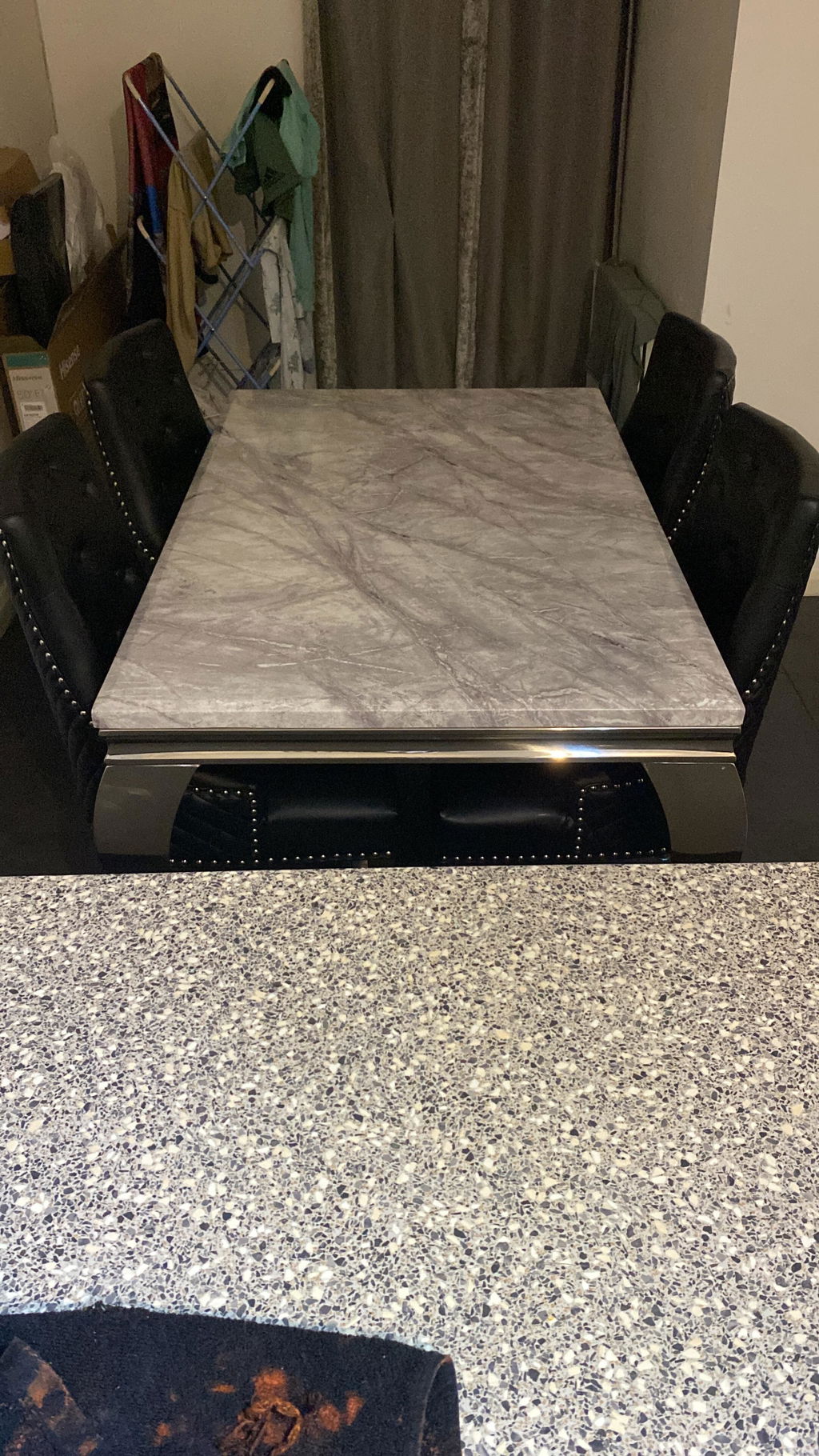
Marble dining tables in round form make a particularly strong visual impression because the full surface is visible and uninterrupted in a way that a long rectangular table doesn't always achieve. The care requirements for real marble apply regardless of shape: sealing, prompt attention to acidic spills, heat protection. Marble-effect ceramic is the more practical alternative where the aesthetic matters but the maintenance commitment doesn't suit the household.
Glass dining tables in round form are a strong choice for a compact room where keeping the space feeling open is a priority. The transparency of the glass top is arguably more effective on a round table in a small square room than on a rectangular one, because the eye reads through the surface in every direction rather than just along a length.
Gold dining tables and chrome dining tables refer primarily to the base and leg finish, and both are available in round configurations. A gold pedestal base with a marble-effect or stone-effect top is a cohesive and considered combination in the right room. A chrome base with a glass top keeps the overall look light and contemporary.
Spreading the Cost
Finance is available on many of our dining tables, subject to status. If the table you want sits above your immediate budget, spreading the cost is worth exploring. We're happy to talk through the options at any point.
Why buy from Shawcross
We're based in Manchester and our showroom is open if you'd like to see round dining tables in person before buying. Diameter and proportion are the things a product page finds hardest to convey: a table that looks compact in a photograph can feel considerably more substantial in a real space, and vice versa. Seeing a round table in person, with chairs around it, gives you a much more reliable sense of whether the size is right for your room.
We deliver nationally across the UK, and you can contact us at any stage for guidance on diameter, room fit, material, or chair compatibility before you order.